Showing posts with label back placement. Show all posts

Wednesday, 6 July 2011

SIDS: Good Habits To Prevent Sudden Infant Death

Baby on her back

The recommendations have long changed. Before we had a baby to sleep on his stomach to facilitate digestion and prevent possible regurgitation. But many studies have shown that this position five times the risk of sudden infant death syndrome. In most cases, there was choking because of blankets or a mattress too soft. A baby under six months is indeed not yet capable of turning around.

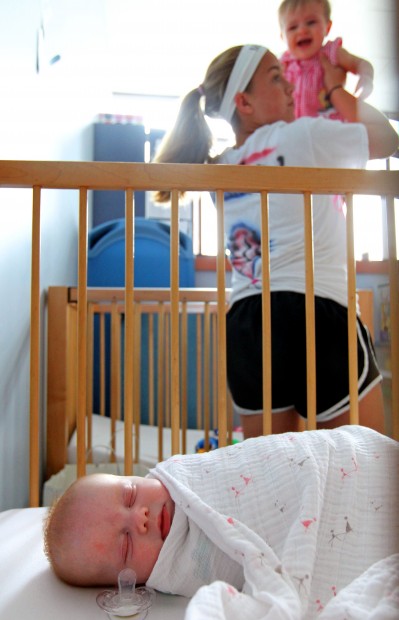
Now for the safety of your baby, pediatricians recommend your child to sleep on their backs, except in very special cases. Since that measures the rate of sudden death has greatly diminished. Adopt the prone position for the games. And you allow him to see his environment in a different way.

Do not worry if you find your baby in a position a little odd, for example glued to the walls of the bed. He seeks contact, the same feeling of security when he was in your belly. It ensures that his face is well clear When lying on your back, your baby should not be hampered by a blanket or soft toys that may come on his face.
Sleep, the perfect outfit is a pair of pajamas, a frog. You can then install it in a sleeping bag or sleeping bag (sleeping bag closed by straps over the shoulders). If it's really cold, you can add thickness, a T-shirt under his pajamas or a wool jacket over it. Optionally, add a light blanket so he can push it easily if it is too hot.
http://www.agehealthily.com/health-news/good-habits-to-prevent-sudden-infant-death

Sunday, 19 June 2011

SIDS: Missouri child-care facilities must put babies on backs to sleep

SIDS Resources of Missouri recommends the following sleep practices to protect children up to a year in age from sudden infant death syndrome or accidental suffocation:
• Practice the ABCs of safe sleep: Babies should sleep Alone, on their Backs in a safety-approved Crib at nighttime and nap time.
• Babies should not be exposed to smoke, and mothers should not smoke during pregnancy.
• Nothing should be in the crib except the baby — no wedges, bumper pads, pillows, stuffed animals, quilts or blankets.
• Consider using a wearable blanket, such as a sleep sack or footed sleeper, instead of blankets.
• The mattress should be firm and well-fitted. If more than two fingers can be placed between the side of the mattress and the crib, the mattress is too small.
It's been 15 years since the American Academy of Pediatrics first recommended putting babies on their backs to sleep to prevent sudden infant death syndrome and accidental suffocation.
Yet, until now, Missouri has failed to incorporate the potentially life-saving practice in any of its child care licensing rules.
That's why SIDS prevention advocates are celebrating a forthcoming state rule that requires licensed child-care facilities in the state to place infants a year and under on their backs at nap time.
"This is a very important rule," said Lori Behrens, executive director of SIDS Resources of Missouri. "We're glad we have it on the books, and it gives us the lead that we need to get in with child-care providers — especially those home-care providers — to do our education on safe sleep."
The rule is in addition to another new one that child safety advocates said has long been lacking: At least one staff member trained in CPR must be on duty at all times in both licensed centers and licensed home day cares.
In an interview earlier this spring, Margaret Donnelly, director of the Missouri Department of Health and Senior Services, said both rules were highly significant and would save lives. The department regulates child care in the state through its Section for Child Care Licensing.
The "back-to-sleep" rule is expected to go into effect by late summer and the CPR regulation by January 1. They will affect about 2,200 centers and another 1,440 licensed home-based child cares. From 2007 to 2009, the Missouri Child Fatality Review Program, which reviews unexpected deaths in young children in Missouri, recorded two infant deaths in licensed child care facilities because of SIDS or suffocation.
The new rules do not, however, apply to the unknown number of legally unlicensed home-based child-care businesses in Missouri, estimated to number well over 5,000, nor to the 670 faith-based child-care centers in churches and other settings that are exempted from licensing in Missouri.
Nevertheless, it's a start, say advocates of quality child care, many of whom have been waiting for such changes.
Missouri has not had a wholesale revision of its child-care rules in two decades. Efforts within the past five years by the state to update those rules have faltered because of budget cuts, changes in leadership and concerns on the part of smaller providers about costs and the scope of regulation. About two years ago, state licensing officials lost funding for consultants to help with the effort, because of state revenue shortfalls. Officials said then that the state would attempt to do the revisions piece by piece.
The new back-to-sleep and CPR requirements are the first new rules to come out of that process. Another rule mandating disaster plans is still under review by the state. Those plans would deal with evacuations, lockdowns and other procedures in the event of weather disasters, fires, kidnapping, bomb threats or other emergencies.
"We are very pleased that child-care licensing has taken this step in the right direction," said Carol Scott, executive director of Child Care Aware of Missouri. "But it's been 20 years almost since we revised the licensing rules in Missouri, and we've learned a lot in 20 years. Over that time, organizations like the American Academy of Pediatrics have made strong suggestions about better protections for children. Missouri hasn't kept up with those recommendations."
Many established licensed child-care providers — particularly accredited ones with independent reviewers — have been abiding by the back-to-sleep rule on their own for more than a decade.
"If I'm giving advice out to parents, I tell them, 'You just need to put your child to sleep on their backs,'" said Lynn Navin, director of the University Child Development Center on the campus of the University of Missouri-St. Louis, which has had such a policy for years. "Too many children are dying because of policies that could be in place that are not."
Susan Horn, head of school of the Downtown Children's Center in St. Louis, said that most of her parents expected to have a back-to-sleep policy and that the center had had one for years. The center posts the policy and prevention message in its handbook, its enrollment papers and on posters in all its classrooms, she said.
"I actually was surprised it wasn't a licensing rule," Horn said. "Just, to me, it's obvious."
But such practices aren't always adhered to in child care — particularly in home-based child care businesses where providers often aren't regulated, have little or no training and are generally older. Until this rule, it had not been a given that licensed centers and homes were adhering to back-to-sleep practices.
National researchers on SIDS have long lamented that most children are dying in home-based care, where providers put babies on their tummies for naps because that is how they raised their babies years ago.
A study nearly a decade ago by Rachel Moon, a pediatrician and SIDS researcher with Children's National Medical Center, determined that 20 percent of all SIDS deaths occur in child care, when that rate should be about 8 percent given babies sleep more hours at home than in child care.
Behrens, of SIDS Resources, said the back-to-sleep rule should be just a start.
"I think that every child-care provider should receive training on exactly what safe sleep means, and that every center and home should have a safe sleep policy — something in writing that says this baby will sleep on their back," she said.
She notes that SIDS Resources also does not recommend crib bumpers or any other type of suffocation hazard in a crib, and advises parents to use blanket sleepers or wearable swaddlers instead of plain blankets.
Navin has personal experience. In the 1980s — long before current research about SIDS prevention — an infant died of SIDS during her first job in a child-care center in another state. When a parent asks Navin to put her child on his or her tummy for a nap because that is what they do at home or the child sleeps better, Navin has no problem saying no.
"It's been 25 years, and I can still see that little baby that was dead in the crib, and I won't do it. I won't."
http://www.stltoday.com/news/local/metro/article_9b68519e-3812-5191-bed7-ca7635901f4c.html

Saturday, 29 January 2011

SIDS: Pennsylvania Experts Back placement is key to preventing SIDS

January 24, 2011
— It is considered the leading cause of death for babies, but the truth is, doctors don’t know the cause.

Sudden infant death syndrome, also called SIDS or crib death, is defined as a death that “cannot be explained after a thorough investigation.”
Instead of a cause, SIDS is a “diagnosis by exclusion.”
Even after a thorough autopsy and review of the scene, no cause can be pinpointed, the National SIDS/Infant Death Resource Center reports.
The unexpected, random nature of SIDS deaths is devastating for parents because it happens despite every precaution, said Dr. Andrew Garbarino of Pediatric Care Specialists, 1322 Eisenhower Blvd., Richland Township.
“Everything would have been normal when they put the baby in its crib,” Garbarino said. “There is no time for the family to prepare.”
There are, however, a few ways to reduce the risk, and a new state law was designed to make sure new parents know the simple steps.
The most important rule is to place babies on their backs.
“Everything we’ve tried to do with monitoring and other measures hasn’t done anything,” Garbarino said. “The only one thing that has been proven to decrease the incidence of SIDS is the positioning of the baby on the back.”
Thirty years ago, the SIDS death rate was between 1.5 and 2 for every 1,000 babies. Since Back to Sleep began in 1994 to promote infant back sleeping and other risk-reduction strategies, that rate has reduced by half, Garbarino said.
Like most hospitals across the nation, all those in the region have provided new parents with SIDS prevention instruction for several years. It is also part of many prenatal classes.
Now Pennsylvania’s Sudden Infant Death Syndrome Education and Prevention Program Act requires all hospitals and home-birth practitioners to give approved instruction. New parents must sign a form showing they understand the information.
“We’ve been educating all along,” Le Ann Kaltenbaugh, education coordinator, said from Windber Medical Center.
“The education is nothing new.”
What is new at Windber is a program to provide each newborn’s parents with a wearable blanket, trademarked the SleepSack, which wraps the baby snugly.
“There are no loose blankets in bed that the baby can be tangled with,” Kaltenbaugh said. “It is very simple. They keep the baby nice and tight. They can’t wiggle out of it.”
Doctors theorize that exhaled carbon dioxide can “pool” under blankets and on the mattress surface, where it is inhaled again by the baby. Doctors believe this can cause death, diagnosed as sudden infant death syndrome, Garbarino said.
It’s important to keep the crib free of stuffed toys or other items that can promote the collection of exhaled gasses, he added.
“No pillows or bumpers – anything that can come against a baby’s face and create pooling – we want to get all that stuff out of the crib now,” Garbarino said.
Despite widespread publicity in recent years, convincing new parents of the importance of back placement can be an uphill battle, Pam Harris, nursery coordinator, said at Memorial Medical Center in Johnstown.
“When we are teaching them, we will get the grandmother in the room saying, ‘I put all my babies on their bellies and they are fine.’ ”
It can be worse for new mothers if the grandparents don’t hear the hospital training, Kaltenbaugh said. It happens the first time Grandma sees her grandchild put to bed face-up.
“It’s a whole new process,” Kaltenbaugh said. “They are going to get from their parents, ‘You can’t do that.’”
In the past, placing babies on their belly or side was thought to reduce the chance of aspirating and choking on vomit, but Kaltenbaugh said research has shown babies naturally turn their heads if they throw up.
Another difficult lesson for new parents to grasp is the danger of letting a newborn sleep in bed with adults. Besides the additional risk of pooling gasses, it is possible for an adult to roll over on a baby without waking up.
“That’s very unwise and there have been bad outcomes,” Tiffany Pugh, nurse manager for obstetrics, said at Memorial.
“The safest for babies is to be in their own crib, rather than in bed with Mom and Dad,” Harris said.
Use of tobacco during pregnancy or around a newborn increases the risk of sudden infant death syndrome, while breast feeding, use of a pacifier and a firm crib mattress can reduce the risk.
But the best way to reduce the risk is putting newborns to sleep on their backs, Garbarino emphasizes, noting it isn’t just while sleeping at home.
One thing parents should do is check their day care centers,” Garbarino said. “A survey of day cares showed very few day care centers were positioning babies on their backs.”
There is one complication from back positioning that parents should watch, Garbarino said. They should alternate which end of the crib where the baby’s head is placed.
“Babies in the crib on the back look out toward the open room,” Garbarino said. If the baby is always put to bed in the same position, it can lead to uneven flattening of the skull and tight neck muscles.
“I tell people to make sure they change the position of the baby in the bed by 180 degrees,” Garbarino said.
Following all the expert advice reduces the risk of crib death, but it does not eliminate all deaths, Kaltenbaugh said.
“It is not something you ever, ever want to happen,” Kaltenbaugh said. “But if it does, you must know you are not responsible. There is nothing you could have done to prevent it.”
http://tribune-democrat.com/local/x530799426/Experts-Back-placement-is-key-to-preventing-SIDS